Guwahati Connect

Jump to solution

Making civic issue reporting more accountable, designing for people who have stopped believing it works.

Role

Solo Product Designer

Tools / Skills

Research, Systems Mapping, IA, UI, Prototyping

Context

Coding Club, IIT Guwahati · Guwahati Municipal Corporation and its citizens

Duration

10 weeks, Spring 2026

Project highlights

Aligned with GMC on the path forward

The Assistant Commissioner confirmed the mechanics work on GMC's existing setup and called it a good long-term direction for the city. He also set out what collaborating would take: the deans, a pitch to the Commissioner, and formal approvals.

Assistant Commissioner, GMC

1st of 35 projects, Techevince IIT Guwahati

First place in the Software domain at Techevince, IIT Guwahati's annual technical exhibition, judged by industry experts and academic staff.

Senior Design Manager, IBM

Problem

Civic issues can disrupt daily life, cost lives, and still go unfixed.

A storm drain blocked since March decides how deep the water gets in June. An open manhole on an unlit lane can cause a fall. These are common enough that the NCRB tracks deaths from civic-body negligence as their own category, covering potholes, open drains, broken footpaths, and live wires left standing in flooded streets.

Uncollected garbage

Potholes

Waterlogging

Non-functional streetlights

Guwahati already has multiple ways for citizens to report civic issues.

Leaves nothing you can point to later
Leaves a record
Direct calls to grievance officers
Letters by post
Call centre helplines
X
WhatsApp
GUCL app
CPGRAMS
Sewa Setu
Assam Housing & Urban Affairs
Swachhata MoHUA app

Every existing app solves one fragment of the problem, chosen by the department rather than by the citizen.

GUCL appstreetlights onlyMeri SadakPMGSY roads only?everything elsesomewhere else

Different issues, different apps

Lodge a grievanceSelect departmentMinistry of …Department of …Department of …Ministry of …?

Expecting a citizen to know where to report

ServicesComplaints

Unclear navigation, poor hierarchy

Every report that goes unanswered makes the next one less likely.

No visibleresponseLowered trustin citizensFewer reportsWorseprioritisationStaff workloadRReinforcing loopIt also runs in reverse.

linkto the full causal loop diagram

Problem statement
Guwahati residents live with civic problems they do not know how to report, and the people who do report cannot find out what happened.
The municipal corporation, in turn, loses the information it would need to direct its limited staff and resources to the places that need them most.

Research

So I interviewed the people that face these problems as well as those responsible for solving them.


Citizens
Non-reporters
Skeptical
Skeptical
Receptive
Receptive
Active reporters
Individual
Individual
Community leader
Community leader
Guwahati Municipal Corporation
Assistant Commissioner
(now ex-) Assistant Commissioner
GMC
GMC engineers
Executive engineers
Executive engineers
GMC

I designed for Sonal, who has never filed a report.

Tanveer

Active Reporter

"I want my city to have the pride I've seen in other countries that are poorer but still keep their streets clean."

Wants

• To see reports actually assigned and acted on, not just logged.

• To create a social impact through his actions.

Barriers

• Poor internet connection in places he wants to report issues from.

• Confusing categorisation of issues and their responsible bodies.

• Managing different apps and mediums for reporting different types of issues.

• Inaction on reported issues.

Sonal

Non-Reporter (skeptical)

"I know [civic issues] are municipal issues, but I sadly don't know anything about how to report them."

Wants

• Reporting to be as easy as using popular consumer apps, without having to talk to municipal officers.

• To report without sharing personal information.

• Accountability and clear progress updates.

Barriers

• Doesn't know how or where to report.

• Doesn't trust that reporting is effective in leading to action.

• Government apps feeling difficult to use.

• Finds gamification off-putting rather than motivating. Says it would make her delete an app, not use it more.

What Tanveer's experience taught me

One pile of garbage can belong to three departments.
The garbage crew takes the garbage and leaves the leaves. Construction debris gets left too, since that belongs to PWD.
"If there's garbage and leaves together, they'll take the garbage and leave the leaves. Construction debris, nobody touches. That's PWD."
Tanveer, Active Reporter
A phone call fixes the pothole and leaves no record it was ever broken.
Workers ask him to call them directly instead of filing, since a call is a private favour and a filed report is a record his supervisors can see.
"They said sir, please don't do this, call me directly. But calling them means letting them not do their job."
Tanveer, Active Reporter
Crews close tickets with a photo taken ninety degrees from the problem.
Crews return to the spot, turn ninety degrees, photograph clean ground, and close the ticket.
"They'll go to the same spot, turn 90 degrees, take a photo, and there's no garbage. So I reject it."
Tanveer, Active Reporter
A worker gave out Tanveer's number, leading to death threats.
Anonymity concerns affected 26.7% of respondents in a 2026 study of Indian grievance platforms.

Ways I considered giving a resident a record, and the one I took forward.

End-to-end voice reporting
Removes the literacy barrier, and leaves GMC nothing to compare a proof-of-fix against.
A WhatsApp bot
The most accessible channel in Guwahati, and the one that breaks the anonymity promise.
A dashcam with AI that drafts reports
Only reaches people with a car and a dashcam, and it films bystanders and number plates.
An app
The only option that produces both an artefact the citizen can point to and a record GMC can aggregate.

Testing

I built a working prototype early so I could find out what I'd got wrong.

linkto the initial prototype

Testing with 10+ people led to one thesis:
Trust
Community
Every screen gives evidence before it asks for anything.

Here's how testing improved the prototype:

Filing a report
Home screen
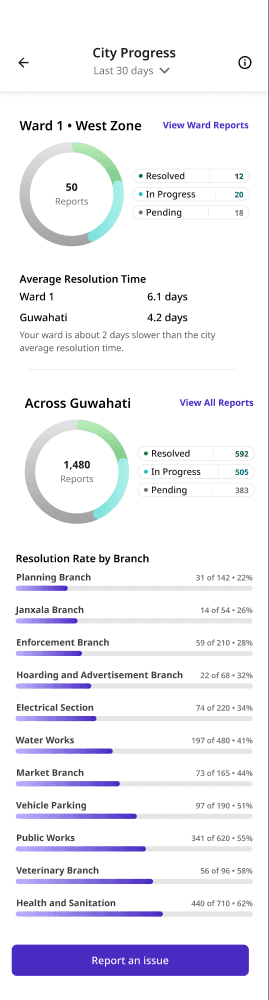
City numbers
Joining a report
Urgency
Filing a report: fewer clicks, less confusion.
Before
Camera, upload and everything else lived on one long page.
After
The report opens straight into the camera, then a three-step flow.

Solution

Filing a report

The full path from home screen to submitted report
Camera first, then the details, a safety check, and a review before it goes.
Camera or gallery, up to three photos.
The same path from the gallery, for a photo already on the phone.
Someone may have already reported it
On the details page a card flags a nearby open report, so duplicates get merged instead of piling up.
If the connection drops, the draft is held.
Submitting offline queues the report as a draft and retries on its own when the signal returns.

Tracking a report to resolution

The estimate keeps the branch on the clock
It shows the expected time to fix, so the citizen is not left guessing. The number comes from GMC's own per-branch resolution data. When it runs out, the report escalates on its own, so the clock is also what holds the branch accountable.
An officer ID, not a name
The counter beside it only rises on resolutions a citizen confirmed, so it cannot be inflated by closing tickets faster.
Joining a report raises its priority
Tapping that you are facing it too moves the count. At ten, the report's priority rises on its own.
The citizen decides whether the fix counts
The worker uploads proof of the fix. The citizen decides whether the fix worked.

Seeing the whole city

The home screen is an argument that reporting works.

Before your first report
Nothing to track yet, so the screen argues the case with resolved reports from nearby wards.
After you have reported
Your own reports come first, because the fastest proof that reporting works is your own report moving.
Period selector
Rates are read against a time window, not as one all-time figure. It sits in the top bar.
Resolution rate by department
An average with no denominator is a claim rather than a number, so volume is shown alongside the rate.
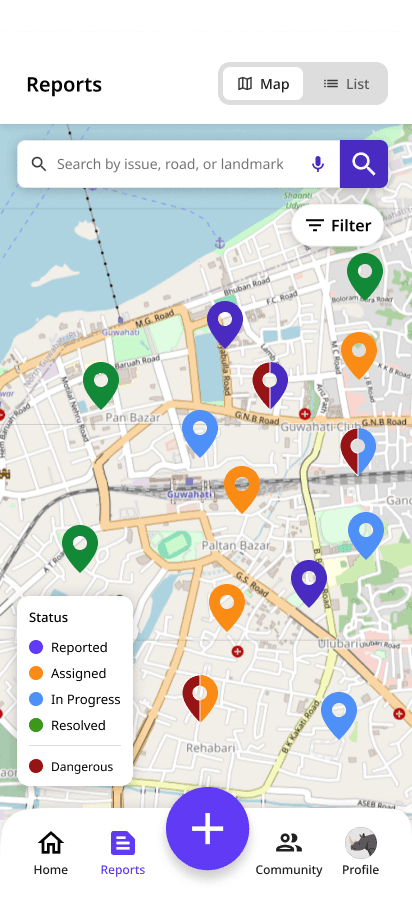
Every report in the city
Public by default, because a record only holds people to account if other people can see it.
Status pins
The same four terms as everywhere else, so the map needs no separate legend.
Filters
Ward, category, status and period, so a resident can check their own street.
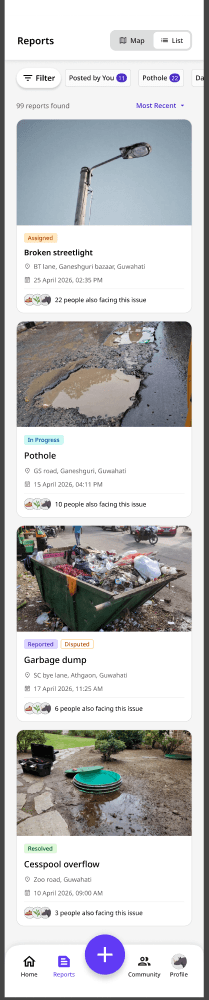
List view
Every report as a card, sortable and filtered the same way as the map.
Notifications keep you posted after you leave the report
Filter by your reports, followed reports, notices and events, and set what reaches you and how in settings, including the WhatsApp consent.

Identity, language and community
Onboarding comes before anything else
The full start, from the splash and language pick through a short overview, OTP sign-up, and three permissions, to the home screen.
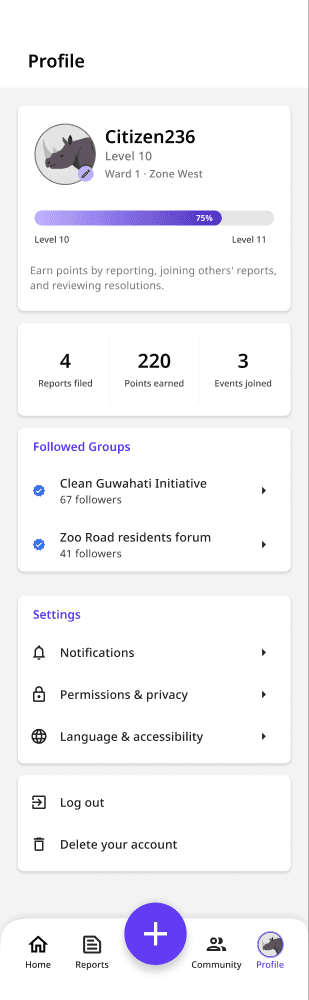
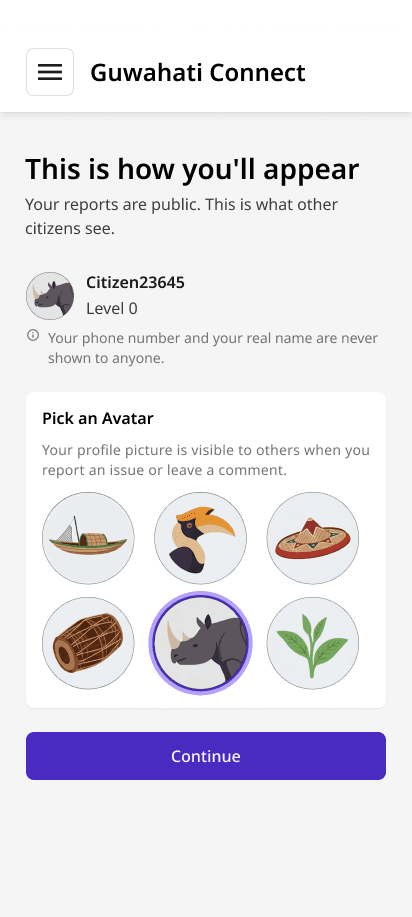
Citizen ID, not a name
Reporting your own street means being identifiable on your own street, so the record carries an ID instead.
Assamese avatars
A preset illustrated set drawn from Assamese visual culture rather than a generic library.
Level tag
Kept, because a visible history is what makes a citizen's confirmation of a fix worth anything.
Your record
Reports filed, confirmed and disputed, held by the citizen rather than by the department.
Log out and delete
A citizen can leave and take the account with them, under the DPDP Act.
The community tab is where the neighbourhood organises itself
Browse and follow groups, get notified about events, see a group's contacts, and propose a new group for approval.

Design System: UX4G 2.0, later updated to 3.0.

I built on UX4G, the Government of India's design system, because a civic app should look like it belongs to the government that runs it. Where UX4G had no component for what this app needed, I built one to its own rules.

Try it for yourself

Outcome

GMC confirmed the mechanics are feasible, then offered to take it up the chain.

Automated assignment between branches is feasible, phone and OTP fits what their systems verify, and it could be linked from the GMC website and published to the Play Store with their officers onboarded. A unified app across all of India would have to go to Chief Minister level.

What I would build next

The staff dashboardTracks time from first report, shows citizens when a report is reassigned, and routes contact anonymously even from GMC staff.
A ward-level pilotUses real SLA data to set the estimates, weighted by how many reports come in from that ward.
The north starExpansion beyond Guwahati, maps integration, and detection that still asks the citizen to confirm.

Reflections

A good idea still needs a realistic scope.

The community layer, points system, and dashboard all expanded the idea beyond what an eight-week solo project could realistically support. I learned that knowing what not to build is part of designing well.

Realized the importance of existing design patterns.

Most of what worked in this app came from studying what already existed. Borrowing proven patterns freed up time for the decisions that actually needed original thinking.

References

Books and papers
Cooper, Reimann, Cronin, About Face. Meadows, D., Thinking in Systems. Arnstein, S. R. (1969), A ladder of citizen participation. O'Brien, Offenhuber, Baldwin-Philippi, Sands, Gordon (2017), Uncharted Territoriality in Coproduction: The Motivations for 311 Reporting, JPART 27(2), DOI 10.1093/jopart/muw046. Pednekar et al. (2026), Reimagining Digital Grievance Redressal Systems, DIS Companion.
Standards and policy
UX4G Design System 3.0. GIGW 3.0. WCAG 2.2 AA. Digital Personal Data Protection Act, 2023. GMC services directory and organogram.
Reporting systems
Swachhata, CPGRAMS, UMANG, Sewa Setu, GUCL, Meri Sadak, Rajmargyatra, ichangemycity, Indore 311, nammakasa.in, NDMC 311, DDA 311, MCD 311, MCF 311, Boston 311, SF311, Chi311, Brampton 311, SeeClickFix.

Let's connect!

© 2026 Ami Pachaury

Let's connect!

© 2026 Ami Pachaury

Let's connect!

© 2026 Ami Pachaury